

£17 billion and rising: what NHS estates teams are up against
The maintenance backlog keeps climbing. The question that decides whether the money is spent well is how much of it you can actually locate.
On 15 October, NHS England published the 2025/26 Estates Returns Information Collection. The cost of clearing the maintenance backlog across the English NHS estate now stands at £17.3 billion. That is up 9.1% on last year's £15.9 billion. £3.7 billion of it is classed as high risk, meaning it must be addressed urgently to avoid catastrophic failure, major disruption or a serious safety breach.
It is a big number and it got the coverage big numbers get. But there is a second question underneath it that gets asked far less often, and it is the one that decides whether any of that money gets spent well.
How much of that £17.3 billion can you actually locate?
Not the category. Not the risk band. The specific asset, in the specific room, with a record you would be willing to defend in a capital bid. If you run a large public estate, you already know the honest answer sits somewhere short of all of it.
This is not only an NHS problem. The same pattern shows up in university estates, local authority portfolios and anywhere a building has changed hands, changed use or changed contractors more than once. The NHS just happens to publish its numbers, which makes it the clearest place to see it.

A backlog figure is a summary of an asset register
Backlog maintenance is an estimate of what it would cost to bring buildings back to an acceptable condition, assessed by risk. It is built up from condition surveys and asset records held by each organisation. The figure inherits whatever quality those records have.
The figure inherits whatever quality those records have.
The industry evidence on that quality is not encouraging. In SFG20's State of Facilities Management research, only one in ten FM professionals said their asset registers were fully accurate. More than a third either did not update them or did not know how often they were updated. SFG20's own consultants point to the same recurring problem: assets recorded with vague descriptions like "boiler" or "pump", which cannot then be matched to the right maintenance task.
NHS England is candid about this in the return itself. It cautions that some data fields are marked as unreliable, where definitions have changed or information has only recently been added to the collection. That is a publisher being straight about its own dataset, and it is worth reading as a warning rather than a footnote.
So the £17.3 billion is directionally right and almost certainly conservative. It excludes planned maintenance entirely, so the true cost of keeping the estate working is higher. But as a basis for deciding what to do on Monday morning, in a particular building, it is close to useless on its own. That is not a criticism of the figure. It was never designed to do that job.
Why the data fragments, and why it is not the estates team's fault
It is tempting to read all this as estates teams not having a grip on their own buildings. That is not what is happening, and anyone who has spent time on a large public estate knows it.
Here is what actually builds up over twenty or thirty years.
Surveys get done at different times by different contractors, each using their own naming conventions and their own idea of what counts as an asset. Buildings change use, get extended, get partially refurbished, and the records follow some of that but not all of it. Information ends up spread across a CAFM system, a building management system, a set of condition surveys, an energy platform, a fire risk assessment, several spreadsheets and, still, a fair amount of paper. Each one is internally consistent. None of them agree with each other.
Then a handover happens. A capital project finishes, hands over a pile of documents, and the operational team inherits data that was structured for building the thing rather than running it. Nobody specified what operations actually needed, because the contract was written around delivery.
None of that requires anyone to have done a bad job. It only requires nobody to have owned the asset data across the whole lifecycle, which is the normal state of affairs. Estates teams are managing the consequences of decisions made by people who left years ago, usually with frozen headcount and a budget that is being asked to cover a £17.3 billion hole.
The expensive mistake
The usual response to a data problem is to buy a system.
It is an understandable move. There is budget pressure, the data is clearly a mess, and there is no shortage of vendors who will demo something that looks exactly like the answer. A digital twin, an IWMS, a new CAFM platform, an asset information system.
The problem is an order-of-operations one. A platform does not create asset data. It displays it, structures it and keeps it current once it exists. Put a fragmented, inconsistent asset register into a good platform and you get a fragmented, inconsistent asset register with a better interface and an annual licence fee attached. Then the twin drifts out of date, because nobody specified who maintains it, and in eighteen months it becomes the thing people stopped opening.
We see this often enough that it is worth saying plainly: if your asset data is the problem, buying software first is the most expensive way to find that out.
The order that works is the other way round. Sort out what you hold, agree how it will be structured, prove it on a small part of the estate, and only then choose the platform that fits the data and the use case. You will also buy better, because you will be able to tell a vendor exactly what you need rather than being shown what they sell.
What it looks like when the data comes first
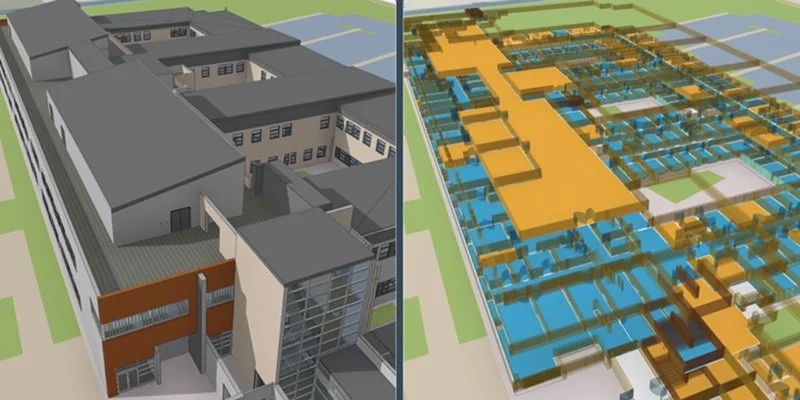
Manchester University NHS Foundation Trust went live with a digital twin across six of its hospitals, covering 274,000 sqm, with the remaining four sites due in a later phase. The work was done on Esri UK's GIS platform with a data strategy from BIS Consult.
The platform is not the interesting part, and the trust would probably say the same. The interesting part is what came before it. Information that had been scattered across multiple systems and paper-based processes was brought together first, so that floors, rooms and spaces could be shown with their associated data attached. David Bailey, the trust's Head of Digital Estates, framed the shift as moving from analogue to digital in order to understand the buildings and assets properly.
The results that followed are operational rather than visual. Digitising asbestos management at one hospital cut preparation time by up to ten days a month. The trust can also see which clinical and non-clinical spaces are being under-used, which is a capital planning input as much as an operational one.
Ten days a month of staff time, at one site, from one workflow.
That is the kind of return that survives a business case review. It did not come from the 3D model. It came from the data underneath it being correct enough to trust.
Six things worth doing before you spend anything
None of these need a procurement exercise. Most of them can be started this month.
-
01
Count your sources of truth. List every system and document that holds asset information: CAFM, BMS, condition surveys, fire risk assessments, energy platforms, spreadsheets, drawings, paper files. Note who owns each one. The length of that list is usually the first useful finding.
-
02
Pick one asset hierarchy and naming convention. Before any software decision. If two systems call the same plant room different things, no platform will reconcile them for you.
-
03
Define what accurate means for your use case. Accuracy for a space utilisation study is not the same as accuracy for a compartmentation survey. Write down the tolerance you need, and validate against it at the start rather than discovering the gap at handover.
-
04
Prove it on one building. Pick a site that is representative rather than easy. Reconcile its data properly and record how long it took. That number is your business case for the rest of the estate.
-
05
Fix handover going forward. Specify the asset information you need as an operational requirement in the next capital project, not as a document deliverable at the end. Otherwise you are adding to the problem while you fix it.
-
06
Then look at platforms, and ask the exit question. When you do get to procurement, ask what happens to your data if you switch supplier in three years, in what format, and at what cost. A vendor who answers that cleanly is telling you something about how they expect to keep your business.
The point
The backlog figure will go up again next October. It has risen every year for a decade. Capital settlements will not close a £17.3 billion gap, and the high-risk portion alone is £3.7 billion.
What is within reach is spending what you do get on the right things, in the right order, with records good enough to defend. That starts with knowing what you have and where it is, which is a data exercise before it is a technology one.
- ERIC 2025/26 official publication and dataset NHS England, Estates Returns Information Collection, 2025/26
- NHS England estates maintenance backlog rises 9.1% to £17.3bn HFMA, 15 October 2026. Backlog £17.3bn, up 9.1% from £15.9bn; high risk £3.7bn; running cost £14.4bn.
- NHS update: maintenance backlog rises to £17.3bn Building Better Healthcare, October 2026. Publication date, risk band breakdown, exclusion of planned maintenance, unreliable data fields caveat.
- NHS estates teams struggling with fragmented asset data Health Estate Journal, on SFG20's State of Facilities Management research. One in ten with fully accurate asset registers; 34% not updating or unsure; vague asset descriptions.
- Manchester NHS launches digital twin at six hospitals Building Better Healthcare, 17 November 2025. Six hospitals, 274,000 sqm, asbestos preparation saving of up to ten days a month, David Bailey quote.
Would your asset data survive scrutiny?
We work with estates teams on exactly this, and we do it without selling a platform. We are not a reseller and we do not take a position on which system you should end up with. That is deliberate, because the advice is worth more when nobody is paying us to reach a particular conclusion.
If you are staring at a condition survey and wondering whether the data underneath it would survive scrutiny, book a 30 minute call. No pitch, no deck. We will talk through what you are holding and where the obvious gaps are, and you can take that away whether or not you ever work with us.
