

The Golden Thread isn’t a document, so why are you storing it like one?
The Golden Thread isn't a document, so why are you storing it like one?
Fire Safety, Fire Strategy, and the Digital Golden Thread. Why the buildings that get this right are building it into a 3D model — not a filing cabinet.
Fire safety compliance has never been more scrutinised. The regulatory landscape has shifted fundamentally, the expectations on building owners and managers have never been higher, and the consequences of getting it wrong have never been more visible. This is unfortunately due to the horrific Grenfell fire tragedy that occurred in 2017.
The Grenfell Tower fire changed everything. Not just in terms of public grief and political response, but in terms of what the law now demands from every person responsible for a building's safety.
The Building Safety Act 2022 introduced a concept that has since become central to how the UK property and estates sector thinks about compliance: the Digital Golden Thread. A complete, continuously maintained digital record of everything that affects the safety of a building — from design intent through construction, refurbishment, occupation, and ongoing operation.
In principle, everyone agrees this is the right approach. In practice, most buildings are nowhere near it.
Try out this fire safety training model example below, created by PPL Training.
What the Golden Thread Actually Requires
The Golden Thread is not a document. It is not a folder of PDFs. It is a live, structured, and accessible information layer that must be maintained throughout a building's entire lifecycle. That means design decisions, structural changes, material specifications, fire compartmentation data, inspection records, maintenance history — all of it, connected, traceable, and retrievable.
For FM directors, heads of estates, and anyone with the role of Accountable Person under the Act, this is a significant operational challenge. Most organisations are still managing this information across a patchwork of systems — spreadsheets, paper-based FRAs, disconnected BMS platforms, and email chains — none of which constitute a coherent Golden Thread.
The gap between what the regulations require and what most teams currently have in place is substantial. Under the Building Safety Act, the role of Accountable Person carries personal criminal liability for higher-risk buildings. This is not a corporate risk to be managed through insurance — it is individual exposure for the person whose name is on the register. That changes the calculus significantly.
Scope: The Building Safety Act's most stringent requirements apply to higher-risk buildings — defined as residential buildings of 18 metres or more in height, or at least 7 storeys, containing at least 2 residential units. For those buildings, the Golden Thread is not guidance. It is a legal obligation with named individuals accountable for its maintenance.
But the principles apply more broadly than the threshold suggests — and regulators have been clear that the direction of travel is toward wider application across the built environment.
The question is no longer whether a digital Golden Thread is worth investing in. It is whether the person responsible for the building can afford not to have one.
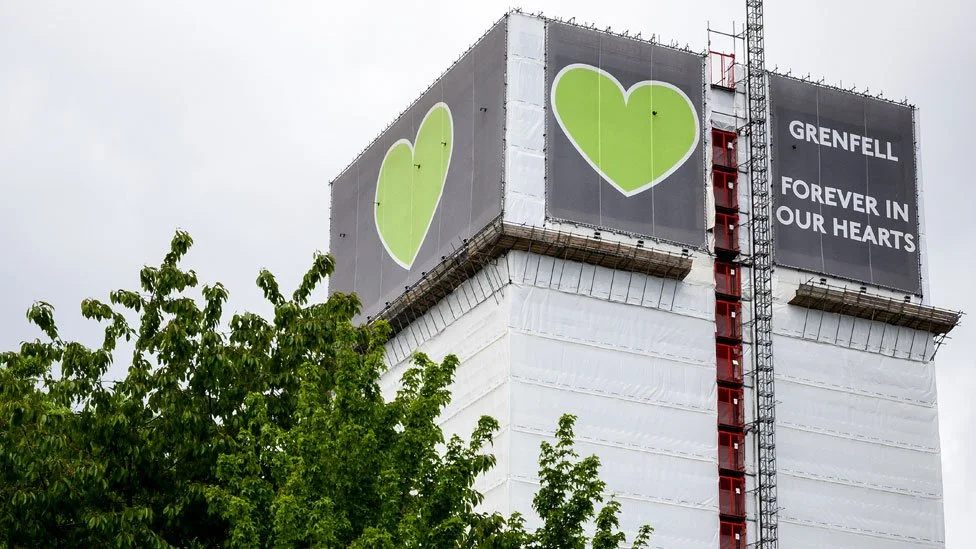
Grenfell Tower being gradually dismantled over the course of two years
Fire Strategy: Where the Data Gaps Have the Most Consequence
Fire strategy documents are produced at design stage. They set out how a building will behave in a fire — compartmentation, means of escape, suppression systems, evacuation procedures. They are typically handed over at practical completion and then sit largely untouched.
The problem is that buildings change. Refurbishments happen. Walls are moved. Ducts are rerouted. Materials are substituted. Each of these changes has the potential to affect the fire strategy — and in many cases, those changes are never formally reconciled with the original documentation.
The result is a fire strategy that no longer reflects the building as it actually exists. In a regulatory context, that is a liability. In a fire event, it can be the difference between an evacuation that works and one that doesn't.
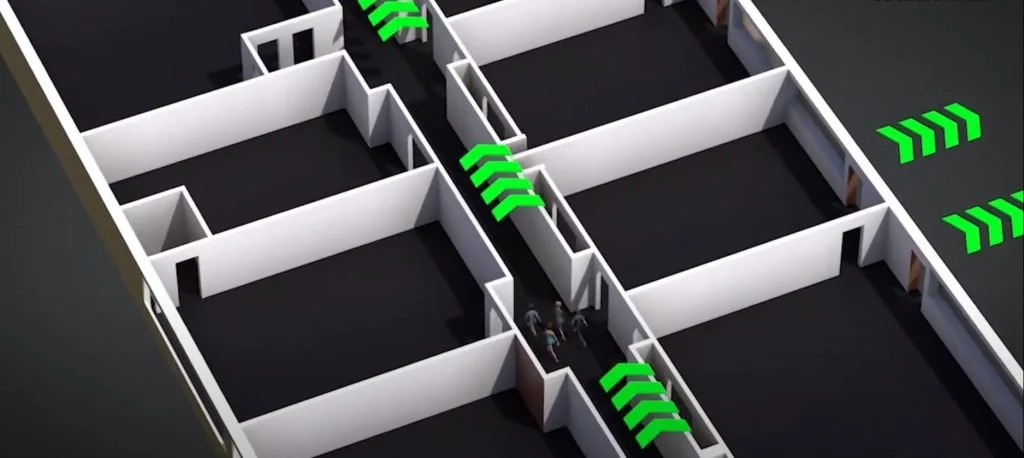
Research published in the Buildings journal identified this precisely: fire alarm systems are typically limited to 2D representations of building interiors, which fail to adequately convey critical spatial information about fire scenes and compartmentation layout. The data is there — it just cannot be understood quickly enough or shared effectively when it matters most.
The Gateway Problem
The Building Safety Act introduced mandatory gateway checkpoints for higher-risk buildings that make the Golden Thread a practical bottleneck, not just a compliance ambition.
Gateway 2 requires a detailed submission of building safety information before construction or major refurbishment can begin — the regulator must be satisfied before work proceeds.
Gateway 3 requires a further submission before the building can be occupied.
Neither gateway can be passed on the basis of a folder of documents assembled under time pressure. The information has to be structured, traceable, and demonstrably complete.
For anyone managing a major refurbishment of a higher-risk building, this is now a programme risk. A Golden Thread that is not being maintained continuously means a gateway submission that has to be reconstructed retrospectively — and a regulator that has every reason to look closely at the gaps.
3D Capture as the Visual Foundation
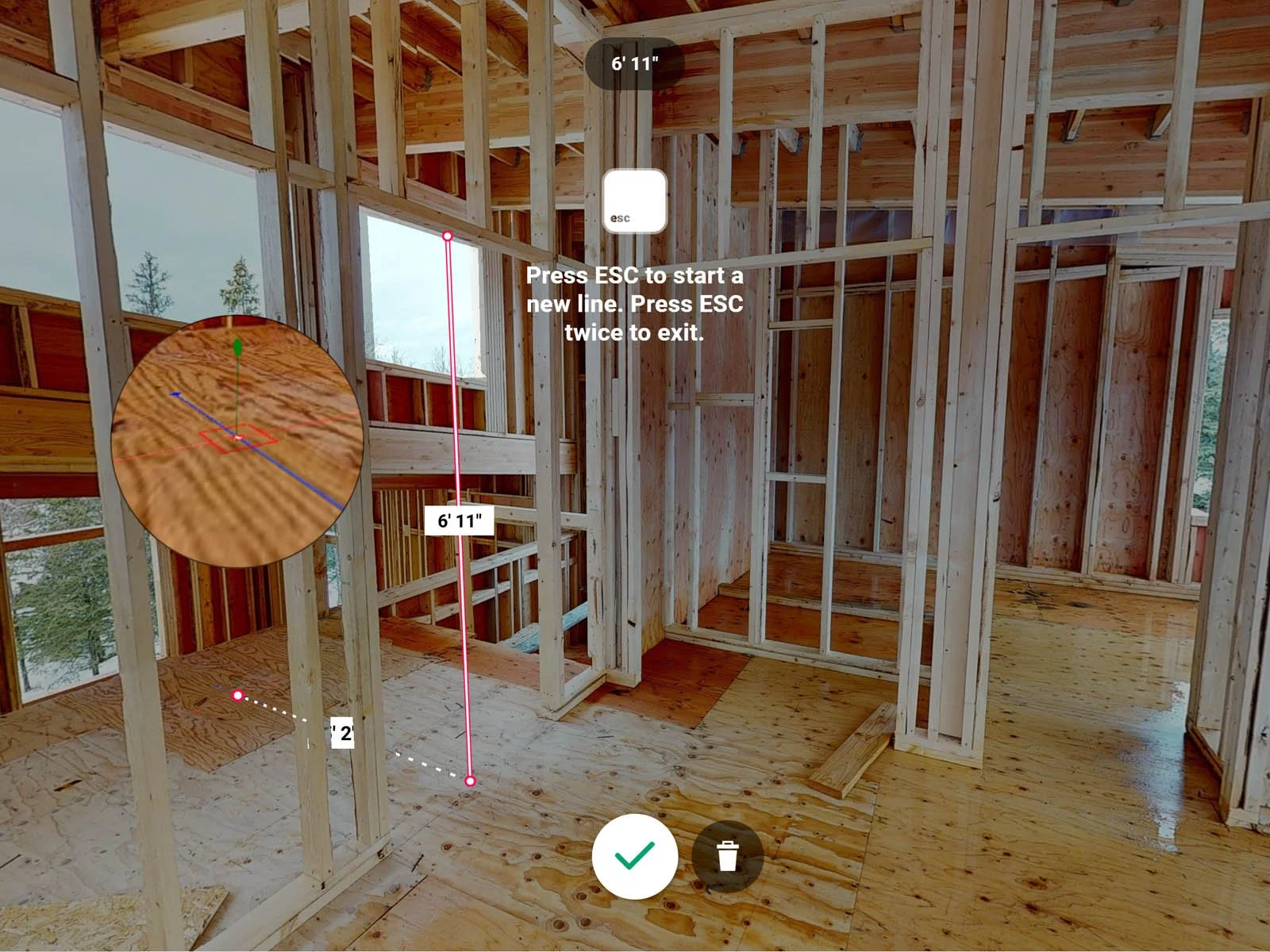
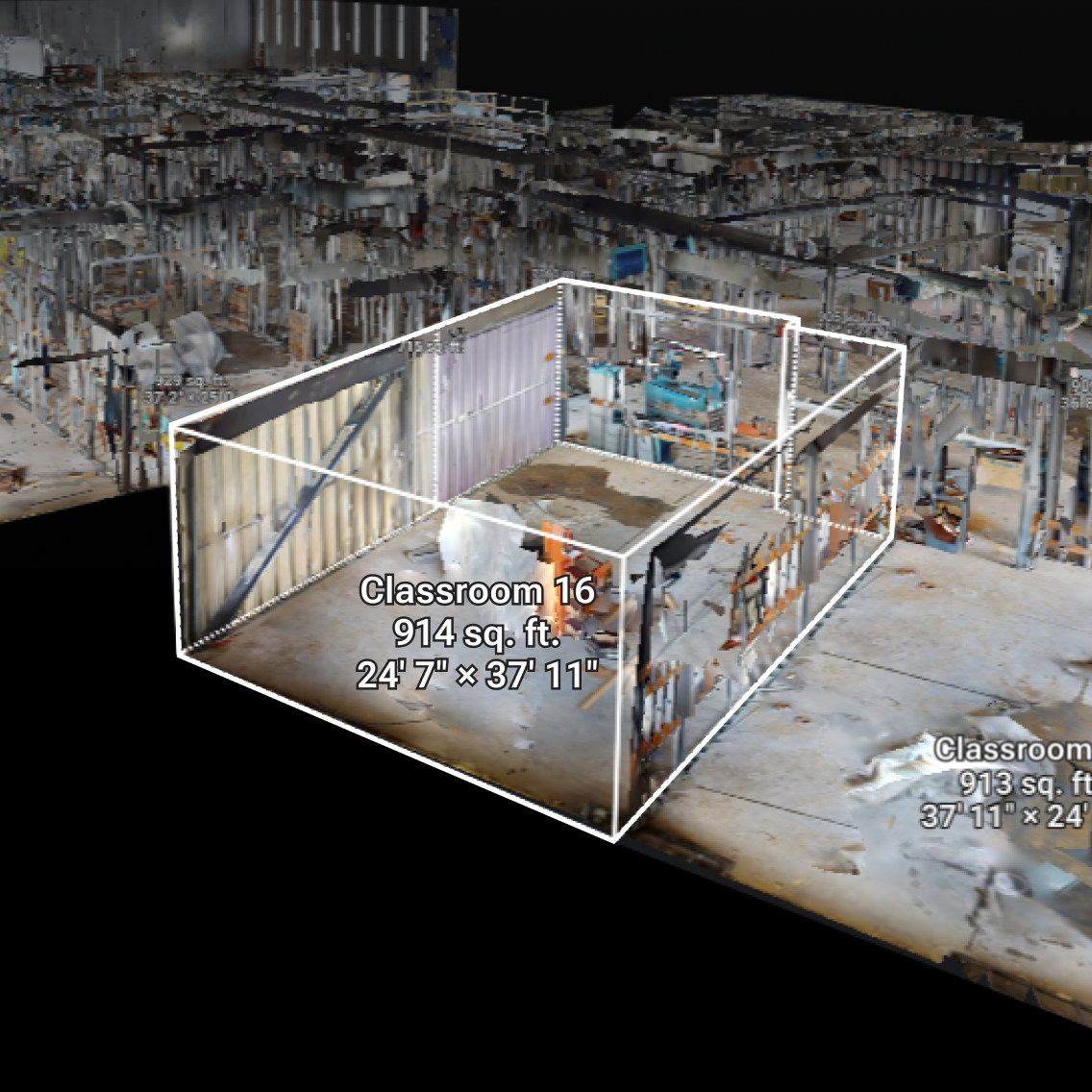
This is where spatial capture technology fundamentally changes the approach. A high-fidelity 3D model of a building — captured using LiDAR or photogrammetric scanning — creates a single visual reference point for everything related to that building's physical reality. Not a schematic. Not a floor plan. A navigable, measurable, spatially accurate representation of the building as it actually stands today.
For fire safety specifically, this changes what is possible across several workflows:
- Fire compartmentation surveys can be documented inside the model itself — not as a separate PDF that needs to be cross-referenced with a drawing, but as tagged, located data anchored to the physical space it refers to. A fire consultant reviewing a wall section can navigate directly to it in 3D, take measurements, and log their findings in context.
- Fire risk assessments become spatially grounded. Every action point, every deficiency, every piece of fire safety equipment can be geolocated within the model. Follow-up inspections reference the same anchored points rather than relying on a written description of a location that may or may not be interpreted consistently by different people.
- Fire strategy reviews become significantly more reliable. When a change is made to the building fabric, the model can be updated to reflect it — and the departure from the original fire strategy becomes immediately visible rather than buried in a version-controlled document that nobody has opened since handover.
- External wall and facade assessments can be captured from above using thermal drone surveying, identifying heat loss, moisture ingress, and potential compartmentation failures in building envelopes that are inaccessible or impractical to survey on foot. For buildings with complex facades — or those subject to EWS1 requirements — combining aerial thermal data with a ground-level 3D model gives fire safety consultants a complete picture of the building envelope that no single survey method can deliver alone.
As Keith Plowman of Global HSE Group has noted, point cloud scans allow fire safety consultants to carry out detailed technical analysis with measurement precision — establishing fire compartmentation and producing detailed fire strategies from a single reference point that streamlines collaboration across the entire team.
The Golden Thread in Practice
The 3D model is the visual layer. But the Golden Thread requires more than visualisation — it requires that information connected to the model is structured, traceable, and can be retrieved over the full lifecycle of the building.
This is where asset management layers become critical. When fire safety equipment — suppression systems, alarm panels, emergency lighting, fire doors — is tagged within the 3D environment, each asset carries its inspection history, maintenance schedule, certification records, and next service date. The link between the physical asset and its compliance documentation is direct and permanent.
What this means in operational terms: when a fire safety audit is conducted, the auditor is not working from a list of asset IDs trying to locate physical equipment. They are navigating a spatial model, clicking on what they can see, and accessing a complete record of that asset's history. When the Accountable Person needs to demonstrate compliance, the information is not assembled from multiple systems under time pressure — it is already there, structured, and accessible.
This is the Golden Thread as it should function. Not a regulatory checkbox. An operational backbone.
Where Fire Safety and Digital Twins Converge
The built environment sector has been slower than others to adopt digital twin technology for fire safety — the academic research confirms this gap. But the trajectory is clear, and the regulatory context is now providing the forcing function that commercial arguments alone rarely deliver.
A research framework developed by academics at Western Michigan University proposed a digital twin approach for fire safety management integrating BIM, IoT sensors, AI, and augmented reality — identifying real-time data acquisition and dynamic monitoring as the foundation for genuinely intelligent fire safety management in complex buildings. The technology components are mature. The integration work is what requires expertise.
For estates teams managing large portfolios — NHS trusts, higher education, social housing, commercial property — the case is particularly compelling. The cost of a non-compliant building under the Building Safety Act is not just financial. The personal liability exposure for Accountable Persons is real and significant. A digital Golden Thread, maintained through a 3D operational layer, is one of the clearest ways to demonstrate that due diligence is being exercised continuously — not just at the point of a scheduled audit.
The trajectory is already visible in live fire operations. In Sardinia, civil protection authorities are using digital twin platforms to model fire propagation in real time — estimating the speed and direction of a fire's spread, coordinating field teams via GPS overlay, and making evacuation decisions before a fire reaches critical zones. That application is in wildfire management, but the underlying principle is identical to what a well-structured building digital twin enables for an estates team: real-time situational awareness, connected data, and decisions made from a single operational picture rather than fragmented sources.
A Note on What This Requires
Getting the Golden Thread right in a 3D environment is not simply a scanning exercise. It requires understanding what information needs to be captured and structured before the scanner is deployed. It requires integrating the spatial data with the asset management, compliance, and maintenance workflows that teams actually use. And it requires keeping the model current as the building evolves — which means embedding capture into planned maintenance and refurbishment cycles rather than treating it as a one-off project.
The technology is not the barrier. The approach is.
The objection most estates teams raise at this point is a reasonable one: we'll capture the building once and it'll be out of date within eighteen months. That is true — if capture is treated as a project.
The organisations getting this right have embedded it differently. Scan updates are scheduled alongside planned maintenance visits. Refurbishment works trigger a re-capture as a standard handover requirement. Minor changes — a relocated fire door, a new partition wall — are logged through a structured change management process tied to the model. The result is a Golden Thread that stays current not because someone remembered to update it, but because the process makes drift structurally difficult.
Organisations that are getting this right are treating the 3D model not as a deliverable to be archived, but as a living operational layer that their estates team genuinely relies on — for fire safety, for compliance walkthroughs, for PPM, and for the day-to-day decisions that building managers make constantly about the assets in their care.
That is what a Digital Golden Thread looks like when it is functioning as intended.
Ready to discuss your digital twin strategy?
Twinflow works with FM directors, heads of estates, and building safety teams to design and implement digital operational layers that support fire safety compliance and the Building Safety Act's Golden Thread requirements.
Book a consultation